
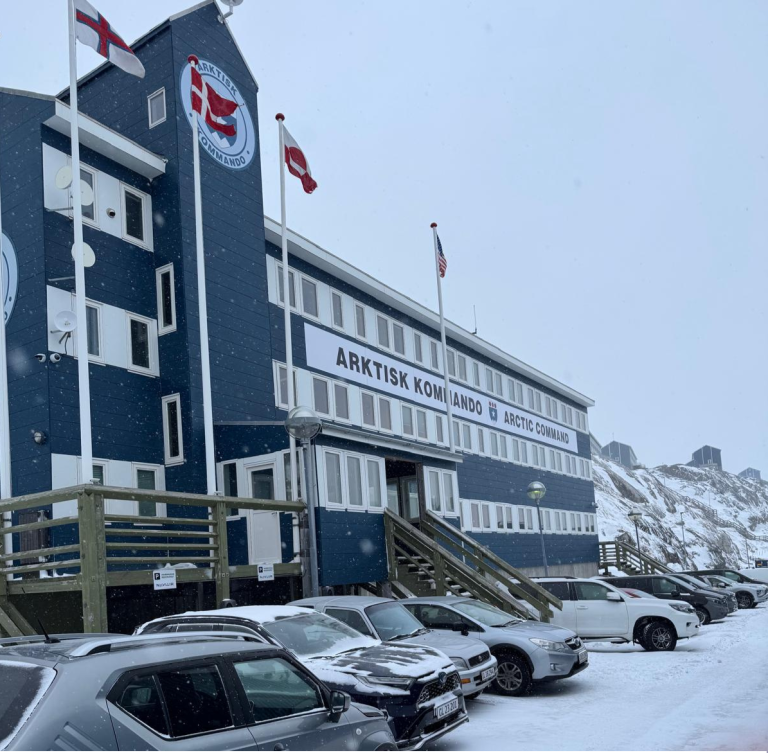

The three American attempts to acquire Greenland differed in scope and purpose. The first, following the Alaska purchase, reflected imperialistic ambitions aimed at countering British influence in North America. The second, proposed by President Truman, was motivated by the onset of the Cold War. However, the third, advanced by President Trump, appeares devoid of clear military strategic logic.
A glance at the map shows that Greenland is part of the Western Hemisphere and a close neighbor to Northeast Canada. Its population is also related to the Inuit or Eskimos living in Canada and Alaska (as well as the Chukchi on the other side of the Bering Strait).
President Trump’s attempt to annex Greenland and Canada to the United States differs from the efforts to buy Greenland in 1867 and 1946. Trump is not the first to invoke the Monroe Doctrine. However, his motives are not security-related, despite his claims otherwise. This is about Trump’s characteristic, idiosyncratic ambition to achieve something that his predecessors in past centuries were unable to do—expand the territory of the United States. The crisis known as “The Greenland Moment” is not over, even though Trump withdrew his threat to use force. Denmark remains on alert. At the same time, Danish Prime Minister Mette Frederiksen’s decisive actions appear to ensure her Social Democratic Party’s success in the general elections end March.
The United States’ interest in Greenland—and Iceland—was a continuation of the purchase of Alaska in 1867. Like Alaska, Greenland would have strengthened the encirclement of British North America and could have promoted the annexation of these provinces to the United States, from which the self-governing dominion of the British Empire—Canada—was formed in 1867.
Alaska, Greenland, and Canada were part of President Andrew Johnson’s administration’s post-Civil War imperialist vision of the United States’ position in North America and the Arctic region. The goal was also to strengthen the defense of North Atlantic Sea routes.
In the same context, the United States offered to buy the Danish West Indies islands (now the U.S. Virgin Islands) from Denmark. Unlike with Greenland, the countries reached an agreement on the sale of the island group, but the deal fell through in the U.S. Senate in 1868. A second attempt in 1902 also failed.
This time, the negotiated agreement was rejected by the Danish parliament. The purchase of the islands was realized during World War I in 1916, as Germany’s submarine warfare threatened North Atlantic shipping. In the same context, the United States recognized Denmark’s sovereignty over Greenland without further reference to Iceland.
Secretary of State William Seward’s negotiated purchase of Alaska was harshly criticized. Nevertheless, the Senate approved it almost unanimously. But due to congressional opposition, Seward had to back down on Greenland. The matter was also affected by the impeachment proceedings against President Johnson. In the end, the United States did not make a formal proposal to Denmark in 1867 to purchase Greenland and Iceland.
The Norse settlement in Greenland ended by the early 1400s. Denmark returned to the island three hundred years later and founded Godthåb, now Nuuk, in 1721. Traditionally, Greenland belonged to the Norwegian crown. After Sweden finally gave up reclaiming Finland in 1811, Alexander I promised Norway to Swedish Crown Prince Bernadotte. Bernadotte’s goal was natural borders, which is why he sought Norway. This was realized in 1814, when, after a short—and Sweden’s last—war, the United Kingdoms of Sweden and Norway were formed. Because “the sea separates but granite unites,” Bernadotte had preferred Norway to Finland and was not interested in “islands,” so the Faroe Islands, Iceland, and Greenland remained colonies of the Danish Realm, which suited Britain, as it did not want to give a strengthened Sweden a foothold in the North Atlantic. At the same time, the British government rejected a proposal that arose in parliament to annex the islands to the United Kingdom.
After Germany occupied Denmark in 1940, Britain sent troops to Iceland, which were replaced by American forces in 1941. The United States immediately recognized Iceland’s independence upon its declaration in 1944. The Americans withdrew in 1947 but returned in 1951 to the established Keflavík air base.
Invoking the Monroe Doctrine, the United States opposed British and Canadian plans to also occupy Greenland in 1940. Instead, it sent the US Coast Guard to protect the cryolite mine in Ivittuut on Greenland’s west coast, which was important for the aluminium industry (now abandoned). The Western Allies fought against German attempts to establish weather observation bases in both Iceland and Greenland, as well as in Svalbard.
In 1946, President Harry Truman’s administration made a secret proposal to Denmark to purchase Greenland, which only became public decades later. The offer of 100 million dollars was rejected. After Denmark joined NATO as a founding member in 1949, the countries signed a defense agreement in 1951. This allows the United States a permanent military presence on the island, including the establishment of Thule Air Base, now known as Pituffik Space Base.
Greenland’s population, about 56,000, lives mainly on the island’s southern and western coasts. The West Greenland Current, branching from the Gulf Stream, affects the west coast’s climate and facilitates maritime traffic. It enables navigation through the Northwest Passage via the Davis Strait, which separate Greenland and Canada.
In contrast, Greenland’s east coast is practically uninhabited. Denmark’s military dog sled teams patrol the area in harsh conditions. In the 1930s, Norway presented Denmark with a territorial claim by occupying an area in Northeast Greenland in 1931. It was named after the Viking Erik the Red, who founded Greenland’s first settlement in 980. Denmark took Norway to the Permanent Court of International Justice, which ruled in Denmark’s favor in 1933. The judgment strengthened Denmark’s position and responsibility for the entire island’s administration, which became a Danish county (amt) in 1953. Greenland received self-government in 1979, which was expanded in 2009. Greenland is not part of the EU, but through Denmark, the island is part of NATO’s area.
Why did Greenland opt out of the European Union? Greenland joined the European Economic Community (EEC, the precursor to the EU) in 1973 alongside Denmark, despite significant local opposition—around 70% of Greenlandic voters rejected EEC membership in Denmark’s 1972 referendum. After gaining home rule from Denmark in 1979, Greenland held its own referendum in 1982, where 53% voted to withdraw from the EEC. The withdrawal was formalized through the 1985 Greenland Treaty, making Greenland the first territory to leave the European Communities.
The primary motivation for leaving was to regain sovereign control over Greenland’s fishing resources and waters.
Post-withdrawal, Greenland became an Overseas Country and Territory (OCT) associated with the EU, allowing it to maintain tariff-free access for its fish exports, receive financial contributions, and permit its citizens free movement within the EU, while staying outside the CFP and EU customs union.
Russia’s interest in Greenland is strategic, as the so-called GIUK line (Greenland, Iceland, United Kingdom) is the maritime chokepoint between the North Atlantic and the Norwegian Sea. However, Moscow supported Trump’s demands regarding Greenland, likely enjoying the spectacle of NATO infighting. The only open dispute in which Russia, Denmark, and Canada are involved concerns the extension of continental shelves under maritime law all the way to the North Pole along underwater ridges in the central Arctic Ocean.
In contrast, Russia’s interest in Norway’s Svalbard is persistent. Russia continually challenges Norway’s sovereignty with smaller and larger provocations. China also has the right, as a signatory to the 1920 Paris Treaty on Svalbard, to conduct scientific activities there, which it does.
China’s interest in Greenland and Iceland is of a different nature. The 2018 Northern Silk Road initiative (Polar Silk Road) speaks to China’s goals as a “near-Arctic state.” China is particularly interested in maritime traffic on the Northeast Passage and seeks to acquire land areas and establish research stations. China’s attempt to build an airport in Greenland was rejected, as was the purchase of a large land area in Iceland. China’s efforts to participate in rare earth metal mining operations in Greenland have not yielded results. U.S. and Danish cooperation in curbing China’s presence is close. China is a significant export destination for Greenland’s fisheries.
What about the United States’ need to ensure its military presence in Greenland? The primary reason remains unchanged. Greenland’s location serves as a forward base to intercept intercontinental missiles flying the shortest route over the polar region. The 1951 agreement imposes no restrictions on the scope of U.S. activities. Cold War-era presence was massive, with the most famous example being the planned placement of strategic nuclear missiles deep under the continental ice. Of these, only the Pituffik Space Base (formerly Thule Air Base) in North-West Greenland remains.
References to the Trump administration’s proposed Golden Dome missile defense system are mentioned as an argument for taking control of Greenland. It is a broad “system of systems,” where space-based early warning sensors, ground- and sea-based radars, interceptor missiles, and later laser- and space-based interception capabilities are combined into a single fire control chain. But it is not Greenland specific. If realized, it would be the implementation of Ronald Reagan’s envisioned Strategic Defense Initiative space defense.